









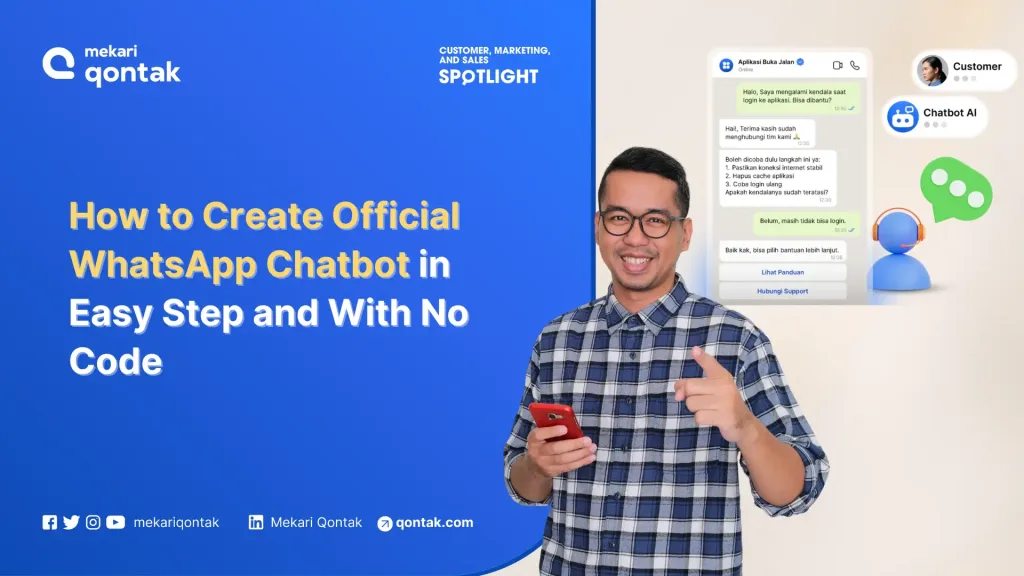
- You can now create a WhatsApp Chatbot without coding, starting with registering for the WhatsApp Business API, connecting your business number, and then building and activating the chatbot’s conversation flow.
- Businesses need to analyze the most frequently asked questions, design natural conversations, provide escalation to human agents, and place the right CTAs.
- Mekari Qontak’s AI-powered WhatsApp Chatbot helps businesses tackle customer service challenges that call for fast, consistent, measurable, and integrated responses through a no-code WhatsApp Business API chatbot.
According to Juniper Research, chatbots are projected to save businesses and consumers more than 2.5 billion working hours every year.
In other words, conversation automation is no longer optional, it has become a standard operating practice for modern businesses, especially on WhatsApp, the primary communication channel for more than 3 billion users worldwide.
Interestingly, creating a WhatsApp chatbot is now far easier than most people imagine. No developer team required, and no coding needed.
In this article, the Mekari Qontak Blog will guide you through how to create a WhatsApp chatbot, from the WhatsApp Business API registration requirements to tips for designing a conversation flow.
What is WhatsApp Chatbot?
WhatsApp chatbot is an Artificial Intelligence (AI) based automated system used to engage audiences and customers on WhatsApp.
This technology can carry out natural conversations to instantly communicate with customers and provide them with information and assistance.
These chatbots are able to comprehend and respond to customers’ inquiries and requests by utilizing natural language processing and machine learning.
As a result, their interactions with businesses are more convenient and personalized.
Before Setup Chatbot: Know WhatsApp Business Official First
The WhatsApp Business API, also known as WhatsApp Business Official (OBA) is a Business account that has been officially verified, as a well-known and authentic brand with a business.
Official Business Accounts have a green tick badge (now is blue tick) on their profile and next to their header in chat threads.
Unlike the usual WhatsApp Business accounts, WhatsApp Business Official has Application Programming Interface (API) technology and various advanced features that can optimally support businesses, such as chatbots, rotators, CRM integration, and many more.
An Official WhatsApp Business account can only be obtained through an Official WhatsApp Partner or Business Solution Provider (BSP) in your country, such as Mekari Qontak.
How to Set up Chatbot WhatsApp?
Here are the steps to create a WhatsApp Chatbot without coding for your business:
1. Register for the WhatsApp Business API
You can create a no-code WhatsApp Chatbot once you switch your account to WhatsApp Business API. To do this, you need to register with an Indonesian Business Solution Provider (BSP) or an official WhatsApp partner such as Mekari Qontak by filling out the registration form.
After registering, you’ll need to verify your account through Facebook Business Manager. Meta (WhatsApp’s parent company) will verify the completeness of your business data, which can take anywhere from 3 days to 2 weeks.
Mekari Qontak WhatsApp API BSP will support you throughout the verification process. In turn, you’ll need to prepare the following data:
- Company name
- Website URL
- Email domain
- Business Identification Number.
2. Connect Your WhatsApp Business Number
Once verified, prepare one phone number that will serve as your business’s WhatsApp number permanently. After that, a blue checkmark will appear next to your business name, indicating that your WhatsApp Business API is active.
Complete your WhatsApp profile by filling in detailed business information that helps customers recognize your business. This can also serve as branding for your business.
3. Activate Your WhatsApp Chatbot
Next, you can start activating the Chatbot feature on the WhatsApp API. Follow these steps:
- Log in to your Mekari Qontak Omnichannel account.
- Go to the ‘Chatbot Menu.’
- Click ‘Conversation’ and select ‘Create Conversation’ to start building the Chatbot’s conversation.
- Enter the required information.
- Then, click “Default fallback.”
- Toggle the AI response switch to enable AI for that conversation, and click “Save changes.”
If you have trouble setting up the Chatbot’s conversation flow, you can consult the Mekari Qontak team. They’ll then build a finalized conversation flow for you.
Be sure to test it first to confirm the chatbot is working properly. Then fix any remaining errors and test it again to make sure the bot works correctly, just the way you want it to.
How does a WhatsApp Chatbot work?
A WhatsApp chatbot works by using natural language processing and machine learning to understand and respond to messages sent by customers.
When a customer sends a message to the chatbot, the message is analyzed and processed to determine its intent and meaning. The chatbot then selects an appropriate response from a pre-determined set of responses and sends it back to the customer.
In order to use a WhatsApp chatbot, a business must first integrate the chatbot with their WhatsApp account. This typically involves creating a bot and API from WhatsApp, which allows the chatbot to access and interact with the messaging platform.
Once the chatbot is integrated, it can be accessed by customers through the business’s WhatsApp account, allowing them to send and receive messages with the chatbot.
In addition to responding to customer inquiries, WhatsApp chatbots can also be used to send automated messages to customers. For example, a chatbot could be used by a company to send updates on an order’s status or reminders about upcoming appointments or promotions.
These automated messages can be personalized and triggered by specific events or actions, allowing businesses to stay in touch with their customers in a more personalized and engaging way.
The Advantages of Building a WhatsApp Chatbot with Mekari Qontak
Building a WhatsApp Chatbot with Mekari Qontak offers a range of advantages that can improve the efficiency and effectiveness of your business operations. Here are some of the key advantages Mekari Qontak offers:
1. A Fast and Easy No-Code Solution
Mekari Qontak provides a platform that lets you build a chatbot without any programming expertise. This means you can design and implement a chatbot that fits your business needs quickly and efficiently, without needing a dedicated IT team.
2. CRM Integration to Maximize Business Efficiency
Another advantage of Mekari Qontak is its ability to integrate with Customer Relationship Management (CRM) systems. This integration enables centralized customer data management, so every customer interaction can be recorded and analyzed more easily and accurately.
In addition, CRM integration allows you to automate repetitive tasks such as scheduling follow-ups, sending emails, and managing leads, which significantly boosts business operational efficiency.
3. Analytics Features to Monitor Chatbot Performance
Mekari Qontak comes with built-in analytics features that let you monitor and analyze chatbot performance in real time. With this feature, you can view important metrics such as interaction volume, response rate, and customer satisfaction.
This data is extremely valuable for understanding how customers interact with your chatbot and identifying areas that need improvement. That way, you can continually optimize your chatbot’s performance to deliver better service to your customers.
4. Omnichannel Integration for Consistent Customer Service
Besides integrating with WhatsApp and CRM, Mekari Qontak offers omnichannel integration capabilities that let your chatbot connect with a variety of other popular communication platforms, such as Facebook Messenger, Instagram, Telegram, and email.
With this feature, you can make sure every incoming message from those various channels is monitored and responded to quickly and consistently. This improves the flexibility and reach of your customer service, while ensuring a seamless customer experience across platforms.
5. Guaranteed Data Security
Customer data security is a top priority in modern business operations. Mekari Qontak understands this and has implemented industry-standard security protocols, including data encryption, access control, and regular data backups.
In addition, Mekari Qontak is certified under ISO/IEC 27001:2022, demonstrating their commitment to safeguarding information security. This means you can be confident that your customer data is handled with great care and in line with applicable legal requirements.
6. Boosting Efficiency
Overall, implementing Mekari Qontak’s chatbot helps improve customer service efficiency. This has been proven by OPPO Indonesia.
By adopting the WhatsApp Business API from Mekari Qontak, OPPO Indonesia successfully improved business efficiency by up to 60%.
This was achieved through automated customer responses and more efficient system integration, enabling their team to handle a high volume of customer interactions more effectively.
Tips for Creating an Effective, High-Converting WhatsApp Chatbot
Having a WhatsApp chatbot and having a chatbot that actually delivers business results are two different things. Here are the principles that set them apart.
1. Start with Customer Problems
One common mistake in chatbot implementation is that businesses build a chatbot based on the features available, rather than the problems customers complain about most often. The result is a chatbot that’s feature-complete but not relevant to actual usage.
A better approach is to audit your chat history from the past 30 days. Identify the 10 most frequently asked questions. Those should be the first priority for your chatbot’s conversation flow.
2. Design Conversations for Humans, Not for Bots
An effective chatbot feels like talking to a capable assistant. Use short sentences, language that matches your brand’s character, and avoid responses that feel generic or overly formal.
One proven technique is adding variation to responses for the same question. Instead of always answering with identical wording, the chatbot can alternate between several different phrasings, making it feel more natural and less robotic.
3. Always Provide an Escalation Path to a Human Agent
Even the best chatbot can’t handle every situation. Customers facing complex issues need a human touch. What’s more, the longer they stay ‘stuck’ in the chatbot, the higher the chance they’ll turn to a competitor instead.
Make sure there’s a button or keyword that lets customers connect directly with a human agent whenever they want, which helps improve response time.
4. Use Strategic CTAs at the Central Points of the Conversation Channel
A chatbot isn’t just an answering machine, it can also become a conversion machine if designed correctly.
Place your Call to Action (CTA) at the right moments in the conversation flow: after the customer receives product information, after comparing options, or after the final qualifying question.
Examples of effective CTAs include: ‘Would you like me to help schedule a free demo right now?’, ‘Click here to see the full pricing,’ or ‘Our team is ready to reach out to you within 10 minutes, may I save your number?’
5. Monitor and Evaluate Regularly
A chatbot isn’t a one-and-done project. After it goes live, monitor its metrics regularly, at least every 2 weeks during the first month.
Also, pay attention to where in the conversation customers tend to drop off most often. Which questions most frequently end up in the default fallback? What percentage of conversations are successfully resolved without escalation?
The answers to these questions form the roadmap for improving your chatbot. The more data you gather, the more accurate and effective your chatbot becomes.
The Difference Between a WhatsApp Chatbot and a WhatsApp Bot
Although the terms ‘chatbot’ and ‘bot’ are often used interchangeably, a WhatsApp Chatbot is easier to build and use for a business’s everyday needs. A WhatsApp Bot, on the other hand, usually refers to a code-based bot that requires API integration.
Meanwhile, here’s a brief table outlining the key differences between a WhatsApp Chatbot and a WhatsApp Bot:
Use Left/Right arrow keys to scroll horizontally.
| Point of Difference | WhatsApp Chatbot | WhatsApp Bot |
|---|---|---|
| Operating Platform | Can be used across various platforms | Only works on WhatsApp |
| Technology | Uses AI and NLP to understand conversations | Generally based on simple, code-based rules |
| Automation | Can handle complex tasks such as bookings and personalization | Limited to FAQs and automated messages |
| Integration | Can connect with CRM, APIs, and other systems | Integrated with WhatsApp’s built-in features |
| Business Use | Suited for multi-platform interactions and complex service needs | Ideal for direct communication on WhatsApp with simple tasks |
Start Building Your Business WhatsApp Chatbot with Mekari Qontak!
Creating a WhatsApp chatbot no longer requires technical expertise or a dedicated developer team. With the right platform, the entire process — from WhatsApp Business API registration to having a chatbot ready to serve customers — can be completed in just a matter of days.
Mekari Qontak’s WhatsApp Chatbot is fully integrated with the official WhatsApp Business API, CRM software integration, an omnichannel inbox, real-time analytics, and Agentic AI.
All in one platform, with no coding required, fully automated, and backed by a team ready to support you from setup through optimization.
Ready to get started? Consult your business needs with Mekari Qontak’s expert team and get a free trial today!
References
Frequently Asked Question About How To Make WhatsApp Chatbot (FAQ)
How much does it cost to create a WhatsApp chatbot?
How much does it cost to create a WhatsApp chatbot?
The cost depends on the platform, chatbot features, number of users, message volume, and WhatsApp Business API setup. Businesses should also consider additional costs related to API usage, software subscriptions, integrations, and chatbot development.
Do I need WhatsApp Business API to create a chatbot?
Do I need WhatsApp Business API to create a chatbot?
For a business chatbot that operates systematically at scale, WhatsApp Business API is generally required. Unlike the regular WhatsApp application, the API allows WhatsApp to connect with business systems such as CRM platforms, customer service dashboards, and chatbot solutions.
What is the difference between a WhatsApp chatbot and WhatsApp Business?
What is the difference between a WhatsApp chatbot and WhatsApp Business?
WhatsApp Business is an application designed to help businesses communicate with customers through features such as business profiles, catalogs, and messaging tools.
A WhatsApp chatbot adds automation to customer conversations, allowing the system to respond based on predefined scenarios, keywords, or AI.
Can a WhatsApp chatbot handle customer service automatically?
Can a WhatsApp chatbot handle customer service automatically?
Yes. A WhatsApp chatbot can automatically handle repetitive customer service requests, such as frequently asked questions, order information, product details, or service schedules. More complex issues can then be transferred to a human agent.
Can I connect a WhatsApp chatbot to my CRM?
Can I connect a WhatsApp chatbot to my CRM?
Yes. WhatsApp Business API can be integrated with CRM systems to synchronize customer information and conversation history. This allows businesses to centralize customer data and give agents access to previous interactions when they take over a conversation.