









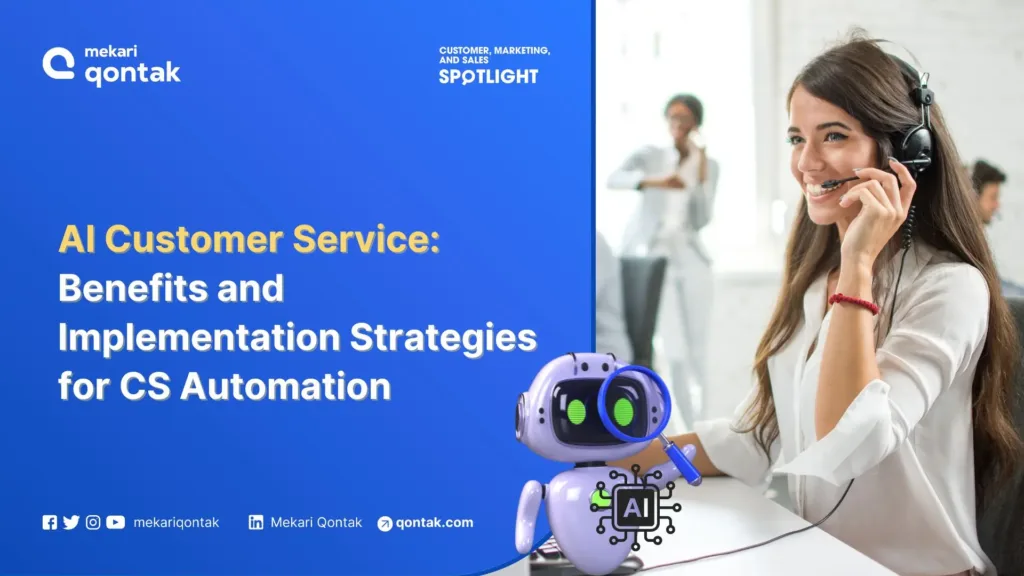
- AI customer service is an AI-based service used by businesses to manage conversations and understand customer needs, as well as automate responses between businesses and customers.
- A well-planned AI implementation can reduce response times, lower operational costs, and increase agent productivity.
- The main challenges of AI CS include limited ability to understand customer emotions, data privacy issues, and the need for initial system training.
- Examples of AI customer service applications range from handling customer inquiries and automated reminders to providing recommendations.
The continuously rising volume of customer messages has become a challenge for customer service teams in many businesses. At the same time, customer expectations are growing higher, with customers wanting responses that are fast, accurate, and available at any time.
This is where AI customer service is transforming the way businesses operate.
It’s not just about automatically replying to messages, it’s about understanding the context of conversations, personalizing responses, and even learning from every interaction to become increasingly intelligent.
In this article, Mekari Qontak Blog will provide a comprehensive breakdown of what AI customer service is, its benefits for businesses, the technologies that support it, and implementation strategies that can be applied right away.
What Is AI Customer Service?
AI customer service is a service system based on artificial intelligence (AI) technology that helps businesses manage customer conversations, automate responses, and analyze interactions between businesses and customers.
The use of AI-based customer service can help your business understand customer needs in order to deliver service that is faster, more efficient, and more personalized.
Unlike conventional automated response systems that only follow fixed scripts, AI customer service uses Natural Language Processing (NLP) and machine learning (ML) to understand the intent behind customer messages.
With these capabilities, AI can answer routine questions such as order status or business hours. Beyond that, AI is capable of processing complex requests, detecting negative sentiment, and transferring conversations to human agents.
Benefits of Adopting AI for Customer Service Needs
In essence, using AI for customer service delivers a positive impact on businesses. Those benefits include the following.
1. Increased Team Efficiency and Productivity
The primary purpose of using AI is to accelerate customer service through automation. AI systems are capable of providing automatic responses to every customer inquiry.
In addition to responding to customers, AI technology can lighten the workload of support agents , such as viewing customer interaction history, searching knowledge base articles, and forwarding tasks to other agents , all without switching screens.
With these capabilities, agents can focus more on complex tasks, increasing their productivity. It is no surprise, then, that 63% of professional customer service workers say AI helps them serve customers faster.
2. Personalization of the Customer Experience
Beyond fast responses, AI can easily understand the context of customer conversations. Responses provided by AI can be personalized by displaying important information such as the customer’s name, location, account type, and preferred language in real time.
If a customer requires a field technician, AI can send all the relevant information to that technician so they can deliver the appropriate service upon arriving at the customer’s location.
3. Non-Stop Customer Service Without Additional Staff
One of the most visible advantages of AI customer service is its ability to operate without interruption. Chatbots and AI agents are ready to respond to customer inquiries outside of business hours, on weekends, and even on national holidays.
This means no more unanswered messages just because the team is offline. Customers receive instant responses, and businesses don’t miss opportunities simply due to limited operating hours.
4. Data Analysis and More Accurate Decision-Making
Every conversation handled by AI is recorded as structured data. From this data, your business can identify the most frequently occurring question patterns, detect potential problem escalations before they happen, and measure customer satisfaction in real time.
This information is of course extremely valuable for managers and decision-makers in formulating service strategies, product development, and more targeted marketing campaigns.
5. Significant Reduction in Operational Costs
Customer service costs, especially those based on volume, can generally be managed more effectively with AI. Chatbots are capable of handling thousands of conversations simultaneously at a marginal cost far lower than hiring additional agents.
Investment in AI customer service can deliver measurable returns within the first 6 to 12 months, especially for businesses with high volumes of customer interactions.
Technologies That Support AI Customer Service
The following are several technologies that support AI customer service.
1. Natural Language Processing (NLP)
NLP is the foundation of AI’s ability to understand human language. This technology enables the system to process freely written text, recognize the intent behind it, and extract important information from conversations.
Without NLP, chatbots can only respond to very specific commands. With NLP, the system is able to understand the various ways customers phrase the same question, in formal language, informal language, or even with abbreviations or typos.
2. Machine Learning
Machine learning enables AI systems to continuously learn and improve their accuracy over time. Every new conversation becomes training data that enriches the system’s understanding of customer need patterns.
This means the longer AI customer service is used, the more accurate and relevant the responses it provides, without the need for manual reprogramming.
3. Chatbot
Chatbot is the most common feature of AI customer service. Chatbots receive customer messages, analyze their needs, and automatically provide relevant responses across various platforms such as WhatsApp, websites, and mobile applications.
Modern AI-powered chatbots are generally far different from older keyword-based bots. AI chatbots are able to maintain conversation context within a single session, recognize topic changes, and deliver responses that feel natural.
4. AI Agent
AI agent is a more advanced version of a chatbot. In addition to answering questions, AI agents are capable of executing more complex tasks , such as creating service tickets, making calls, scheduling appointments, and escalating cases to the right human agents with the conversation context already attached.
5. Sentiment Analysis
Sentiment analysis technology enables AI to detect the emotions behind customer messages, for example, whether they are frustrated, satisfied, confused, or angry. This information is extremely valuable for determining handling priorities and maintaining the quality of interactions.
When AI detects strong negative sentiment, the system can automatically prioritize escalation to a human agent, ensuring that customers who need the most attention receive faster handling.
6. Omnichannel CRM
Omnichannel CRM is an advancement of CRM integration that connects all customer communication channels.
When AI customer service is integrated with Omnichannel CRM, the system accesses customer data and understands the full journey of their interactions across various channels.
With access to purchase history, product preferences, previous conversations, complaints that have been submitted, and the status of contracts or service tickets, AI is able to deliver responses that are far more relevant and personalized.
Challenges and Limitations of AI in Customer Service
There are certainly many benefits to adding AI capabilities to your customer service team. However, that doesn’t mean there are no challenges when implementing AI in customer service.
Here are several things to consider before beginning to adopt AI for your customer service.
1. AI’s Limitations in Understanding Emotional Nuances
Despite continuous advancements in NLP capabilities, AI is still not perfect at understanding complex emotional contexts , especially when customers use sarcasm, regional dialects, or a highly informal communication style.
When AI fails to capture a customer’s true intent and delivers a response that feels cold or irrelevant, the impact can be negative for brand reputation.
For this reason, a fast and seamless escalation mechanism to human agents is very important to have in place.
2. Data Security and Customer Privacy
Another concern that frequently arises when using AI for customer service relates to data privacy security. This is because AI uses company and customer data to train its systems.
For this reason, companies must ensure that the data collected complies with legal regulations, is stored securely, and that customers know how their data is used and processed.
In addition, it is also important to ensure that customers can control their data and know that the data collected is only used for the purposes that have been specified.
3. Complexity of Initial Setup and Training
AI is not immediately intelligent from the moment it is installed. The Large Language Model (LLM) underlying an AI system generally does not yet have specific knowledge about your products, policies, and business context.
However, this challenge can be minimized by choosing a platform that provides an easy-to-use training interface, good documentation, and responsive technical support throughout the onboarding process.
Examples of AI Customer Service Implementation Across Industries
The following are several examples of AI customer service implementation across various business industries.
1. E-Commerce and Retail
In the e-commerce industry, AI customer service chatbots handle questions about order status, return policies, product availability, and recommendations based on purchase history.
In addition, AI also sends automatic notifications when an order is in transit or when there is a promotion relevant to the customer’s preferences.
As a result, the CS team can focus on complex cases, such as payment disputes or complaints about damaged products, that require human empathy and judgment.
2. Banking and Financial Services
Banks and financial institutions use AI customer service to help customers check balances, track transactions, report lost cards, or understand financial products.
In the financial services industry, AI also plays an important role in real-time fraud detection by analyzing unusual transaction patterns.
3. Healthcare and Clinics
Clinics and hospitals utilize AI to simplify the appointment scheduling process, remind patients about consultation schedules or medication pickups, and answer general questions about medical procedures and service fees.
Beyond that, AI also assists in the initial triage process, identifying the level of urgency of a patient’s condition before directing them to the appropriate medical personnel, so that queues can be managed more efficiently.
4. Telecommunications Services
Telecommunications operators use AI to handle very high volumes of complaints, from network disruptions and billing inquiries to package upgrade requests.
When a problem is too complex to be resolved by AI, the system automatically transfers the conversation to a specialized technician or agent with the conversation log already attached, so customers don’t have to repeat their story from the beginning.
5. Tourism and Hospitality
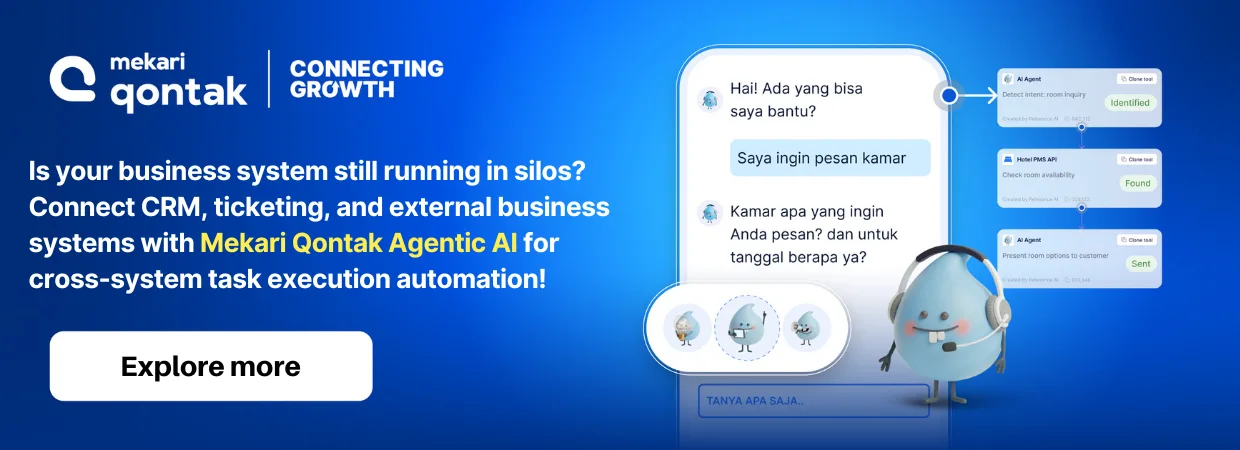
Hotels and travel platforms use AI to help guests book rooms, check availability, submit special requests, or get destination recommendations.
During the stay, AI can function as a virtual hotel assistant that is ready to accept guest requests related to room service, cleaning schedules, or questions about facilities at any time.
Effective Strategies for Implementing AI in Customer Service
Although there are some obstacles you may face when implementing AI for customer service, these can be minimized with the right strategy. Follow these steps when using AI for customer service:
1. Identify Business Needs
Before selecting AI tools, you need to evaluate your business needs and desired outcomes. Here are some questions to consider:
- What specific customer service tasks and challenges do you want to address by implementing AI?
- What are your goals for AI-enhanced customer support?
- How will you measure success (for example, improved customer satisfaction, increased support team efficiency, or reduced response times)?
By answering these questions, you will gain a clear understanding of your objectives and the criteria you need to look for in AI tools.
2. Selecting the Right AI Technology
As you saw in the previous section, there are many AI tools for customer service available on the market. To choose the one most suited to your needs, consider the following factors:
- Features: Evaluate the tool’s capabilities and match them to your needs, such as AI chatbots, ticket automation, or sentiment analysis.
- Integration: Ensure the AI tool can integrate with your existing customer service applications to facilitate a smooth transition and collaboration.
- Scalability: Choose a solution that can grow alongside your business, accommodating increasing customer and team needs.
- Cost: Compare costs, including subscription, installation, and other additional expenses, and choose the one that offers the best value.
- Support and Training: Look for a platform with good customer support and training so you can quickly resolve issues and get the most out of the tool.
- Customer Needs: Ensure the tool aligns with your company’s goals, whether that is making the customer journey easier, more affordable, or faster.
3. Integration with Existing Systems
Once you have selected the ideal AI tool, the next step is to integrate that application into your existing workflow. Here are some strategies to consider:
- Phased implementation: Start by applying AI tools to specific tasks, then gradually expand their use to other areas of customer support. This will help your team become more familiar with the technology and reduce process disruption.
- Training: Ensure your customer service team is trained to use the best AI tools effectively.
- Performance monitoring: Regularly review the performance of AI tools to ensure they are meeting your expectations. Monitor key metrics aligned with your goals and make necessary adjustments to improve results.
- Feedback: Encourage your customer support team and customers to provide feedback and short surveys about their experience with your AI tools. These insights can help improve their functionality and contribute to continuous tool improvement.
4. Start with Specific Use Cases
It is best not to try to automate all customer service operations at once. Start with the highest-volume and most easily automated areas, such as common FAQs, order status checks, or schedule confirmations.
This phased approach allows your team to learn, adjust conversation flows, and measure real impact before expanding the scope of automation.
5. Maintain the Balance Between AI and the Human Touch
AI is most effective when working alongside humans, not replacing them entirely. Ensure the escalation mechanism to human agents runs smoothly, and customers should be able to switch to a human agent at any time without having to repeat the entire conversation context.
This balance is the key to a customer experience that is not only efficient but also feels human and empathetic.
6. Evaluate Performance Regularly
The next strategy is to monitor key metrics such as the conversation resolution rate without escalation, customer satisfaction score (CSAT), average response time, and escalation rate to human agents. Over time, this data will reveal aspects that need improvement.
You can start by scheduling regular evaluation sessions to review conversation flows, update the AI knowledge base, and ensure the responses provided remain relevant to the current product conditions and policies.
Improve Your Business’s Customer Service Quality with AI from Mekari Qontak
As such, AI customer service has become a necessity for improving customer service quality. AI helps businesses deliver fast and high-quality customer service, as well as helps increase agent productivity.
Mekari Qontak Agentic AI offers a fully integrated AI Chatbot solution for customer service, from NLP-based chatbots and Airene integration for conversation recaps and paraphrasing, to an omnichannel inbox.
With ISO 27001 security certification and the flexibility to integrate with WhatsApp Business API, CRM, Instagram, Facebook, Email, and various other business applications, Mekari Qontak is ready to accompany your customer service transformation from start to full scale.
Don’t wait any longer! Consult your business needs and get a free Mekari Qontak demo now!
References
Frequently Asked Question About AI Customer Service (FAQ)
What is the difference between AI customer service and a regular chatbot?
What is the difference between AI customer service and a regular chatbot?
Traditional chatbots are typically rule-based and only respond according to pre-determined scenarios.
AI customer service is more advanced because it can understand intent, learn conversation patterns, access CRM data, and provide more contextual responses.
Can AI customer service replace human agents?
Can AI customer service replace human agents?
Not entirely. AI is designed to handle routine and repetitive questions, while complex cases, negotiations, or escalations still require human intervention. The best model is a collaboration between AI and agents.
Is AI customer service suitable for small and medium-sized businesses?
Is AI customer service suitable for small and medium-sized businesses?
Yes, absolutely! Many AI customer service platforms are now available with flexible and scalable pricing models, making them suitable for businesses of all sizes, such as Mekari Qontak.
Is AI customer service suitable for small and medium-sized businesses?
Is AI customer service suitable for small and medium-sized businesses?
SMBs can actually experience significant benefits because AI enables them to deliver enterprise-quality service without having to hire a large CS team.
How can I ensure customer data is safe when using AI customer service?
How can I ensure customer data is safe when using AI customer service?
Make sure the platform you choose has recognized security certifications (such as ISO 27001), a clear data encryption policy, and compliance with applicable privacy regulations.
Request a detailed explanation from the vendor about how customer data is stored, processed, and protected before beginning implementation.