







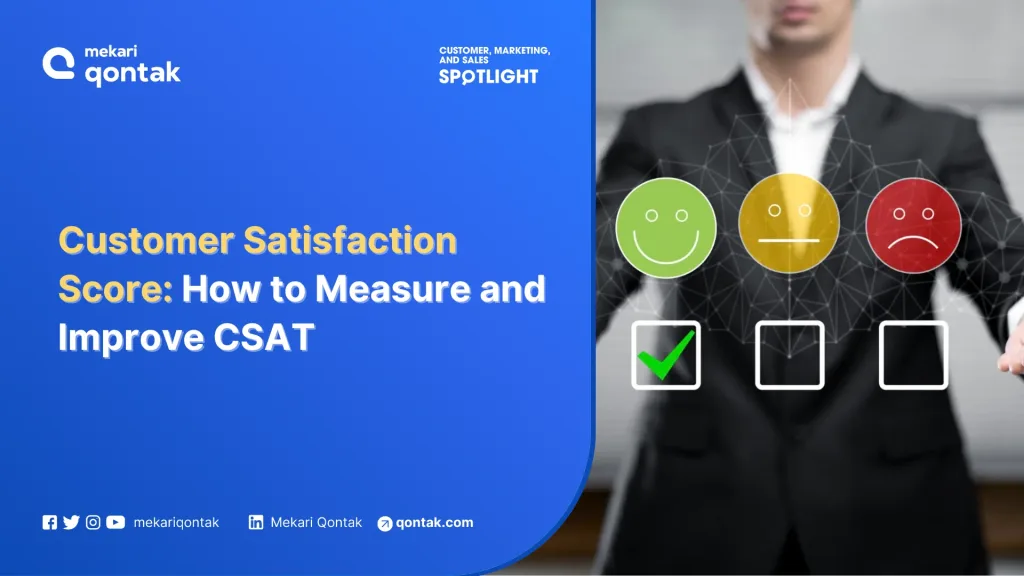
- Customer Satisfaction Score (CSAT) is a metric used to measure how satisfied customers are with a specific product, service, or interaction.
- CSAT helps businesses identify customer issues before they lead to churn, improve customer loyalty, retention, and revenue from existing customers.
- Integrated with customer service software, CSAT helps teams improve response times, reduce agent workload, and turn customer feedback into actionable improvements.
Customer satisfaction score (CSAT) is used to measure customer satisfaction with the experience a business provides. Through CSAT analysis, businesses can identify what customers expect.
Unfortunately, some businesses find it difficult to measure customer satisfaction. Yet customer satisfaction is essential for strengthening customer loyalty, whether that means placing repeat orders or spreading the word to colleagues.
In this article, Mekari Qontak Blog covers what customer satisfaction score is, how to measure CSAT and when to measure it, and the right strategies for improving your CSAT score. Let’s dive into the full discussion below.

What Is Customer Satisfaction Score (CSAT)?
Customer Satisfaction Score (CSAT) is a metric for measuring customer satisfaction. The CSAT metric is a strong indicator for understanding customer needs, identifying their sentiment toward your product, and grouping them based on their expectations.
CSAT surveys are ideally sent when you want to see how happy customers are with a specific product or event you have created.
The responses you collect help you evaluate why customers like your product, why they choose you over your competitors, and what experiences you need to create to drive customer loyalty and retention.
Why Business Should Measure CSAT
There are several reasons why it’s important to measure customer satisfaction (CSAT):
- Improved customer retention: Satisfied Customers are more likely to buy from the business again.
- Increased customer loyalty: Satisfied Consumers are more likely to stay with a company and recommend it to others, which results in increased customer loyalty.
- Enhanced customer experience: A business can identify areas of customer experience improvement and take steps to address them by measuring and analyzing CSAT frequently.
- Increased sales and revenue: Customers who are content with a business are more likely to continue doing business with it and to recommend it to others. The result can increase revenue and sales.
- Improved reputation: A business with high CSAT scores probably has a good reputation. It means the company can get new customers and keep existing ones.
- Improved customer support: A business can identify areas in which customer support can be improved and take steps to address them by measuring and analyzing CSAT regularly.
Why Customer Satisfaction Score (CSAT) Matters for Business
Customers are everything to a business. Without customers, a business will struggle to grow. That is why it is so important for businesses to deliver customer satisfaction.
Customer satisfaction can be achieved through memorable or enjoyable experiences. Customer satisfaction score is useful for measuring customer satisfaction and identifying which parts of the customer journey need improvement.
In addition, satisfied customers tend to upgrade or add services, and they are less likely to cancel.
Discover the Benefits of Measuring Customer Satisfaction Score (CSAT)
Today, many businesses use customer satisfaction score as a KPI for measuring customer success. The main benefits of using CSAT are as follows:
1. Proactively Preventing An Increase In Customer Churn
CSAT helps you proactively prevent customer churn by getting customers to share their problems with you. The best way to uncover them is to ask customers directly. Their answers can give you the insights you need to deliver customer satisfaction.
2. Increasing Revenue From Existing Customers
Customer satisfaction score gives you a clear picture of customer sentiment. It helps you monitor their needs and tells you which customers are satisfied or happy, and which are facing problems.
This information helps the support team sell products that match customer needs.
3. Increasing Customer Loyalty and Experience
CSAT encourages customers to share how satisfied they are with the services or products you offer. From the results of a customer satisfaction score evaluation, businesses can improve their services to create a better customer experience. This can certainly increase customer loyalty.
Explore Types of CSAT Questions
Customer satisfaction is part of how customers respond to every interaction with a brand. CSAT questions are needed to measure the level of customer satisfaction. They can help you evaluate how effective the customer service strategy you have built is.
That is why, when designing a customer satisfaction score survey, make sure you craft your questions and choose your wording so that they are unbiased, accurate, and appropriate for obtaining honest feedback.
The types of questions commonly used in CSAT are as follows:
1. Rating
This type of CSAT question gives respondents a numerical scale, such as 1 to 5, to choose from. A rating scale gives your customers a range to choose from during a CSAT score survey.
You can also use it to gather reviews of your product, customer support, or new features.
2. Binary
This type of CSAT question gives respondents one of two possible answers. For example, yes or no, or thumbs up or thumbs down.
This format can be used where you need an absolute reaction, such as whether your customer received support from your customer experience team, or whether they found what they were looking for in a help article.
3. Likert
Likert questions give respondents a 5- or 7-point scale, where 1 is the lowest number and 5/7 is the highest. This type of question is used to evaluate customer sentiment toward a product. The numbers 1 and 7 represent extreme emotions, 2 and 4 moderate ones, and 3 neutral.
4. Semantic Differential
Similar to Likert questions, this type of question also gives respondents a 5- or 7-point scale, but the wording of the options offered is more descriptive. This allows users to choose the answer that best represents their opinion.
Key Metrics You Can Measure in a CSAT Survey
Surveys offer a simple way to measure the customer experience across various areas of service. You can ask customers to complete a survey after acquiring a customer.
The metrics you can use to measure CSAT are:
- Knowledge and expertise
- Understanding the problem
- Communication
- Professionalism
- Responsiveness
- Resolution effectiveness
- Timely resolution
How to Measure Customer Satisfaction Score (CSAT)
Businesses generally measure satisfaction from customer feedback with options ranging from “Very Satisfied” to “Very Dissatisfied,” represented by a numerical range of 1–5 or 1–10.
CSAT surveys are not limited to one question. If you like, you can use several questions and include both open-ended and closed-ended questions in the same survey.
In questions that measure customer satisfaction, you can create categories such as the following:
- 1: maps to very dissatisfied
- 2: indicates somewhat dissatisfied
- 3: the customer is neutral
- 4: the customer feels somewhat satisfied
- 5: points to very satisfied customer sentiment toward the product
The formula for measuring a CSAT score is as follows:
CSAT score = (number of customers who gave a positive response / total number of customers who responded) × 100%
For example, suppose you collect responses from 100 people. Here, 65 people chose option 4 or 5.
So the total number of satisfied customers is:
CSAT score = (65 / 100) × 100% = 65%
Today, you no longer need to go through the hassle of measuring customer satisfaction manually as shown above. This is because Mekari Qontak has a customer satisfaction score feature that provides detailed reports on your customers’ satisfaction.
Compare Customer Satisfaction Score (CSAT) Benchmarks by Industry
After learning how to measure it, you also need to know the threshold (benchmark) at which a CSAT score counts as good. CSAT values differ from industry to industry.
Generally, however, they range from 75% to 85%. Using the American Satisfaction Index as the standard, the CSAT score for each industry must reach the following numbers to be considered good:
- Garments/Clothing: 79%
- Automotive: 78%
- Mobile Phones: 79%
- Financial Advisor: 77%
- Banking: 78%
- Hotels: 73%
- Life Insurance: 78%
- Computer Software: 76%
- Hospitals: 69%
- Internet Retail: 78%
- Airlines: 75%
- Ambulatory Care: 74%
- Apparel: 77%
- Consumer Shipping: 77%
- Department and Discount Stores: 76%
- Food Manufacturing: 82%
- Full-Service Restaurants: 79%
- Internet Investment Services: 78%
- Internet News and Opinion: 74%
The higher the number you get, the higher your customers’ satisfaction level is as well. You can use these results to build a strategy for improving your service.
Which points probably need to be maintained, and which ones need to be fixed. With a better customer experience, customers are encouraged to stay loyal to your brand.
Choose the Right Time to Measure Customer Satisfaction Score (CSAT)
The timing of a survey sent to gather feedback is very important. This is because your customers’ experience must be recent, or still fresh in their memory, so they can give you honest and unbiased answers.
The right times to send a customer satisfaction questionnaire are as follows:
1. After A Webinar
Sending a CSAT survey after a webinar lets you evaluate how successful your webinar was and assess whether customers have considered the product.
2. After A Product Purchase
Sending a CSAT survey after selling a product, and before handing the customer over to the customer success manager, helps you evaluate your after-sales performance.
3. After Onboarding
Sending a survey after onboarding helps you evaluate the customer’s onboarding experience, and whether there is anything you need to improve and where.
4. After A Product Feature Update
Sending a CSAT survey after a new product or feature release gives you insight into how well your customers adopt the new feature and whether they like it. You can do this with an in-app survey, sent only after users have tried the feature.
5. After Interacting With Customers
Sending a CSAT survey right after a customer interaction is the most efficient and simplest way to understand how effective your customer support is and whether your customers are getting the support they are looking for.
How to Follow Up on CSAT Feedback Results
After you measure customer satisfaction, you may find several points that are customer problems in the CSAT feedback you collected.
You must then make improvements based on the feedback customers provided, in the following ways:
1. Setting Up Service Recovery
First, the most important part is to create a plan for your service recovery flow. To do this, you need to determine which methods and channels to use, as well as who is responsible for the fix.
As a point of consideration, you can ask yourself the following:
- Who will respond to the customer?
- When will it be carried out?
- In what mode (phone, email, face-to-face)?
- What will they say/ask (for example, apologizing, asking for more information to find the root cause, scheduling a follow-up call for more details, etc.)?
- How will you empower your staff to handle these calls?
- What information do they need to make the call?
- What is the expected outcome of the follow-up?
2. Prepare An Analysis Plan
Second, you need to develop a data analysis plan. This is very important because it systematizes how you look at how the feedback will be used, how it relates, etc.
The following points should be included in the plan you create:
- Include the following background information to help keep the analysis focused on what matters, such as the aims and objectives of the survey and what questions you are trying to answer/what problems you are trying to solve.
- Think about the type of analysis you need to perform, how you want to prepare it, and how you want to present it. This includes the tools to be used for the analysis.
3. Analyze The Data
Analyze the feedback in many forms because there will be many different types of data to make sense of. Not only survey data, but also the customer data you have added.
Run crosstabs, identify drivers, and prioritize using the survey data. Don’t forget to analyze your unstructured data.
Also run a linkage analysis to connect customer and employee data, customer feedback with operational metrics, and all data with financial measures.
4. Synthesize and Contextualize The Data
Combine all parts of the analysis into a single conclusion and turn it into actionable points. The conclusion you arrive at should be easy to understand and translate into a better customer experience.
This synthesizing skill is not easy to find or learn, but it is an essential part of making sure the data is actionable.
5. Share The Data and Information You Obtained
Share the data or information collected across the company in a way that lets people know what to do with it.
This information needs to be shared with the teams or departments that have a stake in the feedback. That way, improvements involving commitments of time, funds, and other resources can be made.
6. Develop A Strategic Plan For Taking Action
Before you take action, you must plan it. Ask yourself the following questions:
- What are the common problems, themes, or trends emerging from the data?
- How can/will departments respond to these insights?
- What will be fixed?
- What improvements are needed to create a policy?
- What tools are needed?
- What communication is needed to ensure the whole team or department agrees with the necessary changes?
- Are there best practices that can be shared with other departments?
7. Take Action On The Feedback
Finally, take action on the feedback using the plan you have created. For example, if you learn that a product feature is broken, you should prototype a fix, test it with customers, and gather feedback again, quickly.
Once you have implemented the new or improved experience, make sure employees are trained on the new tools or processes that facilitate it.
Tips for Improving Your Customer Satisfaction Score (CSAT)
Even if you have a good or above-average CSAT score, there will always be room for improvement. The goal is for your business to keep growing and become much better. Follow these tips to improve your business’s CSAT score:
1. Design A Customer-Centric System
Being customer-centric means putting customers’ interests first in everything you do. So, before you make or design decisions related to anything you will do, it is best to ask: “How will this affect customers?” and “How will they feel?”
2. Don’t Overlook The Role Of Employees
Without employees, you have no customer experience. You need to make sure you listen to your employees and improve their experience as well. You can start by asking:
“Do they have the tools, resources, and processes they need to serve customers in the proper way, or in the way customers want?”
If you have never asked this before, you will be surprised by the answers.
3. Train and Empower Your Employees
CSAT metrics should be used to measure customer satisfaction after specific interactions with company employees, especially support agents.
The feedback you receive can be used to train your team so they are better prepared to meet expectations and handle common complaints.
4. Conduct In-Depth Analysis
Use predictive and prescriptive analytics to identify the best next action to take to make sure customers achieve the outcomes they want, how much effort is required, and what the impact will be on customers and the business.
5. Open More Support Channels
Open new channels for your customers, such as SMS or Live Chat, to serve them as quickly as possible. This is key given that 75% of customers expect to receive help in as little as five minutes.
If you feel you are trying to do too much and your CSAT score is dropping as a result, fix your current support channels first.
6. Respond To Dissatisfied Customers On Social Media
When faced with poor customer service, 20% of consumers will complain publicly on social media. If you choose to ignore those complaints, you will certainly see your CSAT score drop.
On the other hand, customers who have a positive social media customer service experience are almost three times more likely to recommend a brand.
7. Give Your Customers Short Tutorials
Often, customers are dissatisfied with a product or feature because it is not as user-friendly as they would like. Create a tutorial plan for your customers.
This can include anything from short video tutorials to employees setting up one-on-one meetings with customers.
Track Your Customer Satisfaction Score Easily with Mekari Qontak
Customer satisfaction score (CSAT) helps identify the gap between customer expectations and the service actually delivered. The CSAT metric can help businesses identify the level of customer satisfaction and how well you meet their needs.
From this metric, you can see how satisfied customers are with your business’s products or services. Next, you can measure CSAT to evaluate and make improvements to the products or services you provide in order to increase customer satisfaction.
Mekari Qontak customer service software integrates CSAT into a unified service workflow, helping teams automate satisfaction measurement, improve response times, reduce agent workload, and act on customer feedback more effectively.
Learn more about Mekari Qontak CSAT solution and how it can help your team turn customer feedback into actionable insights for better service performance.
Discuss your business needs with Mekari Qontak Expert and get a free trial now.
Frequently Asked Questions About Customer Satisfaction Score (FAQ)
What is a good CSAT response rate?
What is a good CSAT response rate?
There is no single response rate that applies to every business. A useful benchmark depends on factors such as customer volume, survey channel, and how frequently surveys are sent.
Your businesses should monitor response rate alongside CSAT to ensure the score reflects a meaningful portion of customer feedback.
How often should a business measure CSAT?
How often should a business measure CSAT?
The frequency should follow the volume and nature of customer interactions. Businesses with frequent customer interactions can measure CSAT regularly, while businesses with longer customer journeys may collect feedback at key milestones.
What is the difference between CSAT and customer satisfaction?
What is the difference between CSAT and customer satisfaction?
Customer satisfaction refers to how customers perceive their experience with a business, product, or service. CSAT is the metric used to quantify that satisfaction based on customer feedback.
Can CSAT be measured across different customer touchpoints?
Can CSAT be measured across different customer touchpoints?
Yes. Businesses can measure CSAT across different touchpoints, such as onboarding, customer support, product usage, or post-purchase interactions.
How should businesses segment CSAT data?
How should businesses segment CSAT data?
CSAT data can be segmented based on factors such as customer segment, product, service channel, interaction type, or support team. This allows businesses to identify patterns that may be hidden when all customer responses are analyzed as a single overall score.