








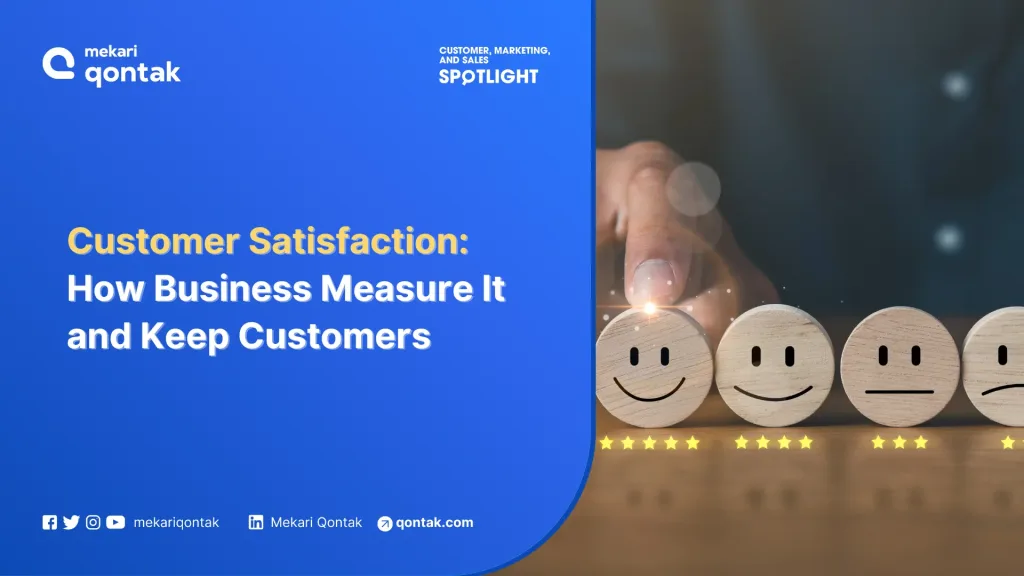
Customer complaints have hit record levels.
Customer satisfaction measures how well your products, services, and overall experience meet customer expectations. When you leave that gap unmeasured, churn builds quietly and then arrives all at once.
This Mekari Qontak Blog guide explains what customer satisfaction means, which metrics reveal it, and which factors your team can influence first.

What is Customer Satisfaction?
Customer satisfaction is a measure of how well a product or service meets a customer’s expectations.
It is a key factor in determining the success of a business, as satisfied customers are more likely to continue using the product or service, recommend it to others, and give positive feedback.
Customer satisfaction is typically based on a variety of factors, including the quality of the product or service, the reliability of the company, the convenience of the purchasing process, and the overall value for money.
To measure customer satisfaction, businesses often use surveys, questionnaires, and other methods to gather feedback from customers.
Improving customer satisfaction is important for businesses because it can lead to increased customer loyalty, positive word-of-mouth marketing, and improved financial performance.
Companies can work to improve customer satisfaction by identifying and addressing customer needs and expectations, offering high-quality products and services, and providing excellent customer service.
Read also: Customer Segmentation: Strategies and Real Examples
Why is Customer Satisfaction Important?
Customer satisfaction is important for a number of reasons. Here are a few:
1. Increased customer loyalty
Satisfied customers are more likely to continue using a product or service, and they may also be more willing to try other products or services offered by the same company.
This can lead to increased customer loyalty, which is valuable for businesses because it can result in repeat business and a steady stream of revenue.
2. Positive word-of-mouth marketing
Satisfied customers are often more likely to recommend a product or service to their friends, family, and colleagues.
This type of positive word-of-mouth marketing can be valuable for businesses because it can lead to new customers and increased sales.
3. Improved financial performance
When customers are satisfied with a product or service, they are more likely to continue using it, which can lead to increased sales and revenue.
In addition, satisfied customers may be willing to pay more for a product or service, which can also contribute to improved financial performance.
4. Competitive advantage
Companies with high levels of customer satisfaction often have an advantage over their competitors.
This is because satisfied customers are more likely to choose the company’s products or services over those of its competitors, which can lead to increased market share and revenue.
Overall, customer satisfaction is important because it can lead to increased customer loyalty, positive word-of-mouth marketing, improved financial performance, and a competitive advantage in the market.
Factors That Influence Customer Satisfaction
Now that you know what customer satisfaction means, it’s time to look at the factors that can influence how satisfied a customer feels.
Here are the customer satisfaction factors you need to know:
1. Product quality
Customers always expect good product quality, or at least quality that matches the price. Quality that meets expectations makes customers happy, while dishonest product descriptions can lead to disappointment.
2. Product price
A price that’s competitive in the market is an important factor. Customers will feel satisfied when the price of your product is fair for its quality. They’ll also appreciate discounts or promotions that are honest.
3. Product or service availability
Product availability greatly affects customer satisfaction. Make sure your products are always in stock to meet demand. Stock shortages or hard-to-find products can disappoint customers and push them to go elsewhere.
High-quality products must always be available to meet customer demand. Stock shortages can disappoint customers, so make sure your stock levels match your market’s interest.
3. Customer service
Good service is essential throughout the transaction process. Customers expect to be treated kindly and to feel cared for. Poor service can leave customers disappointed, even when the product quality is great.
4. Accessibility
Quality products at affordable prices must be easy to get. This includes how easy it is to find and buy products, whether online (through a fast website) or offline (for example, without having to wait in long lines).
6. Technology
Advances in technology allow businesses, from small to large, to carry out digital marketing.
As a result, consumers now expect every store to have access to technology that makes transactions easier, such as messaging services, social media, or a professional website. The availability of this technology has become an important factor in increasing customer satisfaction.
Benefits of Customer Satisfaction for Businesses
Customer satisfaction can bring valuable benefits to a business. When customers are satisfied with your products or services, they won’t hesitate to place repeat orders again and again.
Here are the benefits of customer satisfaction for businesses:
1. Forecasting sales proactively
Metrics such as CSAT (Customer Satisfaction Score) help sales and marketing teams plan strategies based on customer feedback. With these insights, you can make more proactive decisions to increase sales.
2. Gaining new prospects and customers
Loyal customers not only contribute to a high CLV (Customer Lifetime Value), but also become the company’s biggest promoters, attracting new customers through recommendations.
3. Becoming a selling point
Customer satisfaction can be a convincing supporting argument during the sales team’s pitch. Marketing can also use satisfaction levels as a powerful campaign to attract potential customers.
4. Increasing customer loyalty
It’s no secret that retaining customers is far more cost-effective than acquiring new ones. This can be achieved by keeping customers satisfied.
The approach is simple: understand their needs, solve their problems, and build a closer relationship.
5. Retaining existing customers
The main reason customers switch brands is often a poor experience. A Microsoft survey reported that 61% of respondents had switched to a competitor because of poor customer service.
Making sure all customers feel satisfied is essential, because it takes many positive experiences to make up for a single negative one.
6. Increasing business sales and revenue
The close relationship between customer satisfaction, repeat orders, and recommendations has a direct impact on sales.
Satisfied customers tend to come back, buy more often, and bring in new customers, which ultimately increases your business’s overall sales and revenue.
Tips for Improving Customer Satisfaction
Here are some tips to help you improve your business’s customer satisfaction effectively and efficiently:
1. Improve product quality
As a business owner, you should continually monitor product quality and make sure the items you ship are in good condition. If you sell food, make sure the ingredients are fresh and the food tastes great. Maintaining product quality will increase customer trust and satisfaction.
2. Offer competitive prices
Price is an important factor. You don’t always have to offer the lowest price, but make sure it’s reasonable and proportionate to the quality you provide. Customers will appreciate fair prices and honest promotions.
3. Give gifts or bonuses
Give gifts or bonuses to your loyal customers. This way, you’ll make them feel valued and special. You can also run a giveaway program on social media to attract new customers.
4. Provide a warranty or money-back policy
When a product is defective or doesn’t match its description, offer a warranty or a refund policy. By giving customers the option to exchange the item or get their money back, you show that you take responsibility. This builds trust and leaves customers feeling satisfied.
5. Be honest with consumers
Honesty is the key to success. Never lie about your product or service descriptions. Even if a small lie doesn’t seem to have an immediate impact, it can damage your brand’s image in the long run.
6. Create a good promotional strategy
Create appealing promotional strategies, such as discounts or other programs, to win over consumers. It’s also important to make sure the quality of promotional products isn’t careless, so customers aren’t left disappointed.
How to Measure Customer Satisfaction?
There are a number of ways that businesses can measure customer satisfaction, including:
1. Surveys
Surveys are a common way to gather feedback from customers.
These can be conducted online, by phone, or in person, and they often ask customers to rate their satisfaction with various aspects of a product or service, such as quality, reliability, and value for money.
2. Net Promoter Score (NPS)
The Net Promoter Score (NPS) is a measure of customer loyalty. It is calculated by asking customers how likely they are to recommend a product or service to others, on a scale of 0 to 10.
Customers who score 9 or 10 are considered “promoters,” while those who score 0 to 6 are considered “detractors.” The NPS is calculated by subtracting the percentage of detractors from the percentage of promoters.
3. Customer Effort Score (CES)
The Customer Effort Score (CES) is a measure of how easy it is for customers to interact with a company.
It is calculated by asking customers to rate their level of effort required to resolve a problem or complete a task, on a scale of 1-7.
4. Customer Satisfaction Index (CSI)
The Customer Satisfaction Index (CSI) is a measure of overall customer satisfaction with a product or service.
It is typically calculated using a combination of survey responses and customer feedback.
5. Customer Complaints
Tracking the number and type of customer complaints can also be a useful way to measure customer satisfaction.
This can help a company identify areas where it is falling short and take steps to improve.
It’s important to choose the right method for measuring customer satisfaction based on the needs of the business.
A combination of methods may be the most effective way to get a comprehensive understanding of customer satisfaction.
Elevate Customer Satisfaction in Your Business with Mekari Qontak!
Customer satisfaction rarely drops because of one big failure. It erodes through slow replies, repeated questions, and conversations that disappear between channels.
Mekari Qontak Customer Service Software brings WhatsApp Business API, Instagram, and other channels into one omnichannel inbox, tracks every request through ticketing and SLA management, and lets a Chatbot AI answer routine questions 24/7.
With CSAT collection after each resolved conversation, your score reflects real interactions instead of occasional surveys.
Explore Mekari Qontak Customer Service Software to see how it fits your service operation.
Discuss your business needs with Mekari Qontak team and start a free trial now.
Referensi
Frequently Asked Question About Customer Satisfaction (FAQ)
How do you calculate CSAT?
How do you calculate CSAT?
Divide the number of satisfied respondents by the total number of respondents, then multiply by 100. Many teams count scores of 4 and 5 on a five-point scale as “satisfied.”
What is a good CSAT score?
What is a good CSAT score?
It depends on your industry, survey scale, and type of interaction. Compare against your own trend first, then against industry benchmarks such as ACSI industry scores.
Can a satisfied customer still leave?
Can a satisfied customer still leave?
Yes. Satisfaction measures how customers feel about experiences that already happened. Competitor pricing, changing needs, or the effort of getting help can still push customers away.
What is the difference between customer satisfaction and customer experience?
What is the difference between customer satisfaction and customer experience?
Customer satisfaction is the outcome: how happy customers are. Customer experience is the full journey that produces that outcome, from first advertisement to after-sales support.
When should you send a satisfaction survey?
When should you send a satisfaction survey?
Send CSAT right after an interaction ends, for example when a ticket closes. Run relationship surveys such as NPS on a fixed schedule so you can compare trends between periods.