









- AI Agents for Lead Qualification are autonomous software programs that engage, filter, and evaluate prospects across your pipeline
- They solve the speed-to-lead gap by instantly processing data and scoring inbound traffic around the clock
- The system utilizes predictive machine learning models to analyze buying intent instead of following rigid scripts
- Automating these administrative discovery tasks drastically reduces client acquisition costs while maximizing sales team efficiency
- Seamless CRM integration ensures real-time pipeline routing and data enrichment for better revenue predictability
Timing is everything in sales, yet a massive execution gap persists in modern revenue operations.
This sluggish response is a structural process-level problem that drains marketing budgets and starves the sales pipeline.
This Mekari Qontak Blog article explores AI Agents for Lead Qualification, breaking down how this intelligent technology bridges the speed-to-lead gap, works autonomously beneath your tech stack, and drives exponential pipeline velocity.
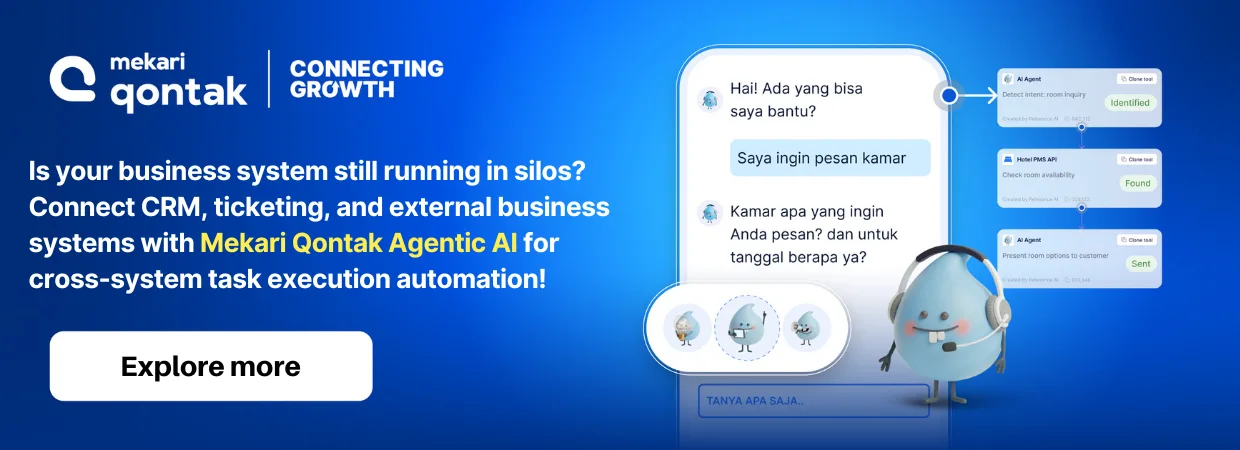
What Are AI Agents for Lead Qualification?
AI Agents for Lead Qualification are autonomous software programs powered by large language models and predictive algorithms that businesses deploy to engage, filter, and evaluate inbound and outbound prospects across the sales pipeline.
As a highly advanced AI lead qualification agent, this technology functions as an autonomous AI SDR (Sales Development Representative).
Instead of following traditional automation rules, these AI agents read conversational context, analyze real-time buyer behavior, and verify prospect data.
They handle early-stage discovery round-the-clock, ensuring that your human sales reps spend 100% of their active selling time exclusively on high-value, sales-ready opportunities.
How AI Agents for Lead Qualification Actually Work
1. Lead Capture and Signal Detection
The qualification process begins the moment a prospect interacts with your brand.
The agent captures inbound actions across web forms, emails, or chat widgets, while simultaneously monitoring critical intent signals such as pricing page visits, whitepaper downloads, or specific search queries.
2. AI-Powered Lead Scoring Using Predictive Models
Once a lead is captured, the system applies predictive lead scoring algorithms.
By leveraging Natural Language Processing (NLP) and machine learning, the agent evaluates how closely the prospect matches your Ideal Customer Profile (ICP), gauges their emotional sentiment, and analyzes engagement patterns to predict their likelihood to buy.
3. Real-Time Enrichment and CRM Data Population
Before a human ever sees the lead, a lead enrichment agent runs in the background.
It instantly pulls missing data points such as company size, annual revenue, technographics, and decision-maker job titles from external databases like LinkedIn or Apollo, executing an AI-powered CRM integration that updates your records automatically.
4. Intelligent Lead Routing to the Right Sales Rep
Once qualified, the system uses CRM integration lead routing protocols to assign the prospect.
Based on customized routing rules such as geographic territory or deal size, the agent dynamically matches the lead to the most suitable account executive without requiring manual administrative review.
5. Automated and Personalized Follow-Up Across Channels
Finally, the agent orchestrates sales pipeline automation through targeted outreach.
It triggers tailored, multi-touch automated sales follow-up AI sequences across email, WhatsApp, or SMS, automatically adapting the messaging and channel delivery based on the prospect’s real-time responses and behavior.
The Business Impact of AI Agents for Lead Qualification
1. Faster Speed-to-Lead: From Hours to Seconds
An intelligent agent shrinks median lead response times from over 36 hours down to under 60 seconds. Instantly engaging a prospect when their buying intent peaks unlocks a 21x conversion multiplier, keeping your brand ahead of slower competitors.
2. Higher Qualified Lead Volume Without Adding Headcount
Automating the heavy lifting of pipeline filtering allows you to scale your pipeline effortlessly. B2B companies utilizing autonomous lead generation engines see an average 73% increase in qualified lead volume within just six months, bypassing the need for costly hiring cycles.
3. Reduced Cost Per Lead and Improved SDR Efficiency
Deploying an AI agent slashes your client acquisition friction by lowering the cost per lead by an average of $2.40. Furthermore, by offloading data entry and cold outreach, it saves individual SDRs 11 to 12 hours per week, allowing them to focus entirely on closing deals.
4. Improved Pipeline Predictability and CRM Accuracy
AI-driven data enrichment ensures your sales records remain accurate and comprehensive. Maintaining an enriched database yields 35% higher conversion rates and 21% shorter sales cycles, seamlessly aligning marketing data with sales execution.
5. Positive ROI Within 12–18 Months
Comprehensive market analysis reveals that comprehensive AI sales transformations deliver a 4.2x average return on investment within 12 to 18 months. The primary drivers of this rapid financial return are automated lead scoring, programmatic nurturing, and frictionless CRM synchronization.
AI Agents for Lead Qualification Implementation
1. High-Volume Inbound Lead Triage from Website Forms
- Scenario: A growing SaaS company receives over 300 website form submissions per week. The sales team is buried in manual data entry, meaning hot leads grow cold before an SDR can review them.
- With AI agents: The inbound lead qualification agent enriches and evaluates each lead instantly. It flags the top 20% highest-value prospects, surfaces them to account executives within 60 seconds, and queues the remaining long-tail leads into automated nurturing workflows.
- Outcome: SDR administrative burden drops by 40%, and qualified meeting bookings increase by 22% within the first month.
2. Re-Engagement of Cold Leads from a Stale CRM
- Scenario: A B2B enterprise has 5,000 dormant contacts sitting in their database for 6 to 18 months. Manual prospecting into this cold list is inefficient for human SDRs.
- With AI agents: The agent monitors behavioral intent signals—such as historical email opens, recent content downloads, or sudden website revisits. Leads that cross a predefined priority threshold automatically trigger a tailored re-engagement sequence.
- Outcome: 15% to 20% of cold database contacts are reactivated into warm sales opportunities without any human rep time investment.
3. Multi-Touchpoint Lead Qualification Across Channels
- Scenario: A B2B firm targets enterprise accounts where busy decision-makers ignore cold emails, making an omnichannel customer engagement AI strategy necessary.
- With AI agents: The agent evaluates the prospect’s historical engagement to determine their preferred communication medium. It orchestrates a synchronized outreach strategy—sending emails to executives, personalized WhatsApp messages to field reps, and interactive voice drops to emerging market leads.
- Outcome: Human reps secure 2x to 3x more qualified meetings, while overall prospect response rates climb by 47%.
4. Validating BANT Criteria Before Human Sales Handoff
- Scenario: A sales division relies on the BANT qualification framework, but reps spend 40% of their workweek manually digging for budget, authority, need, and timeline data.
- With AI agents: The system utilizes custom logic to automate BANT checking. It enriches company revenue data (Budget), scans job titles (Authority), reads conversation history for business pain points (Need), and checks contract renewal dates from public records (Timeline), only passing leads that hit all parameters.
- Outcome: Time-to-qualified-conversation drops from 5 business days to under 8 hours, massively boosting SDR productivity.
5. Autonomous Qualification for Night-Time and Weekend Inbound Traffic
- Scenario: A global B2B vendor catches 30% of its inbound leads outside standard office hours. These submissions sit unaddressed for up to 48 hours, resulting in severe lead decay by Monday morning.
- With AI agents: The agent provides immediate conversational triage. It initiates a real-time qualification chat, scores the prospect, updates the CRM records, and places them into the correct pipeline stage instantly, all before the human team begins their shift.
- Outcome: Speed-to-lead delays decrease by 82%, maintaining near-zero lead decay during weekends and holidays.
What to Look for When Implementing AI Agents for Lead Qualification
1. Data Readiness
Clean your internal database, remove duplicates, and standardize form inputs before deployment to ensure the AI engine references accurate foundation metrics.
2. Choosing the Right Qualification Framework to Configure Into Your Agent
Map out your exact qualification rules (like BANT or MEDDPICC) so the AI agent can calculate lead scoring automation in perfect alignment with your sales playbook.
3. CRM and Tech Stack Integration Requirements
Choose an agent with native, bi-directional API connections to your central CRM software to maintain real-time pipeline visibility across both marketing and sales teams.
4 Human-in-the-Loop
Establish transparent handover parameters to define exactly when a conversation should switch from autonomous nurturing to active human sales intervention.
5. Common Mistakes That Cause AI Lead Qualification to Underperform
Most underperforming projects fail due to poor goal-setting, vague prompt constraints, or static configurations. To secure success, constantly audit conversation logs, adjust predictive scoring weight, and regularly update your content knowledge base.
Accelerate Your Sales Pipeline with Mekari Qontak AI Lead Qualification Agent
Implementing autonomous intelligence within your lead management workflow is the ultimate lever to eliminate speed-to-lead latency and maximize your pipeline yield.
Moving from manual sorting to intelligent filtering ensures every inbound lead is prioritized instantly.
To help your revenue operations scale smoothly, Agentic AI Mekari Qontak provides the enterprise-grade foundation your business needs.
Backed by features like an adaptive Agentic AI engine, a unified Omnichannel CRM database, and seamless WhatsApp Business API integration, Mekari Qontak automates early-stage sales discovery from first touch to closed deal.
Stop losing high-intent buyers to slow manual follow-ups. Consult your sales architecture goals and start a free trial with Mekari Qontak today to optimize your pipeline efficiency!
Frequently Asked Questions About AI Agents for Lead Qualification (FAQ)
What is an AI agent for lead qualification, and how is it different from a chatbot?
What is an AI agent for lead qualification, and how is it different from a chatbot?
It is an autonomous software that evaluates prospects. Unlike chatbots that follow strict, static decision trees, an AI agent understands complex context, enriches data, and makes independent pipeline decisions.
Which lead qualification framework works best when integrated with an AI agent?
Which lead qualification framework works best when integrated with an AI agent?
Frameworks like BANT and MEDDPICC work best. AI agents can easily automate these by cross-referencing firmographic data for budget and analyzing conversation history for explicit business needs.
How many leads does an AI qualification agent need to process before the scoring model becomes accurate?
How many leads does an AI qualification agent need to process before the scoring model becomes accurate?
Advanced models like Mekari Qontak deliver high accuracy from day one using pre-trained frameworks. However, precision continually optimizes after processing a few hundred industry-specific interactions.
Can AI agents for lead qualification work without a CRM?
Can AI agents for lead qualification work without a CRM?
Yes, but it is not recommended. While they can qualify leads independently via email or WhatsApp, a CRM integration is vital to route leads and prevent pipeline data silos.
What human tasks should remain in the qualification process even when using AI agents?
What human tasks should remain in the qualification process even when using AI agents?
Humans should handle final deal negotiations, manage high-value relationship building, handle emotional escalations, and consistently audit the AI’s conversation logs for performance tuning.